
BRIDGEWATER, N.J., JUNE 23, 2026
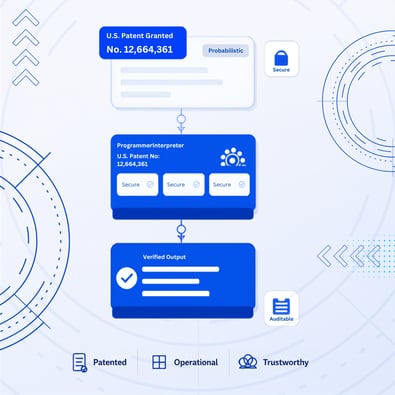
Openstream.ai, the leading provider of neuro-symbolic multimodal Collaborative Agentic and Conversational AI solutions for visionaries, today announced that the United States Patent and Trademark Office has granted U.S. Patent No. 12,664,361, covering its System and Method of Programmer-Interpreter Approach for Large Language Model Post-Editing.
The patent addresses one of the most pressing obstacles to enterprise AI adoption: the inability to systematically verify, correct, and validate LLM-generated outputs before they reach end users or downstream systems. Despite the rapid proliferation of generative AI, organizations in regulated industries, including banking, insurance, and healthcare, have deployed LLMs broadly, yet remain exposed to a fundamental limitation: by their nature, LLM outputs are probabilistic rather than deterministic, making it difficult to guarantee accuracy, consistency, or auditability at the level enterprises require. Closing that gap is the defining requirement of Operational AI.
“Enterprises don’t have an AI generation problem; they have an AI trust problem,” said Magnus Revang, Chief Product Officer at Openstream.ai. “LLMs are extraordinarily capable, but when the stakes are high, such as an underwriting recommendation, a compliance summary, a clinical note, ‘usually right’ isn’t good enough. This patented architecture makes AI outputs systematically auditable and correctable, not as an afterthought, but as a first principle baked into how the system reasons. That’s what moves AI from a productivity experiment to a mission-critical capability.”
The technology is integrated into Eva™, Openstream.ai’s Enterprise Virtual Assistant platform, and complements the company’s broader neuro-symbolic AI architecture. Where Openstream.ai’s existing patents address how AI systems plan, coordinate, and ingest enterprise knowledge, this innovation specifically targets the post-generation phase: the critical moment where raw LLM output is transformed into a response that meets enterprise standards for accuracy, auditability, and compliance.
“Enterprise buyers are sophisticated. They’ve moved well past the pilot stage, and they’re asking hard questions about governance, liability, and operational control,” said David Stark, Chief Marketing Officer at Openstream.ai. “This patent moves AI discussions within enterprises from pilot hesitancy ‘how do we know the AI got it right?’ to ‘We have clear, defensible answers’ for growth and ROI.”
The grant further strengthens Openstream.ai’s intellectual property portfolio across planning, multimodality, knowledge extraction, and multilingual orchestration, representing a comprehensive architecture for enterprise AI that is trustworthy at every stage, from the first input to the final decision.
ABOUT OPENSTREAM.AI
Openstream.ai is the leading provider of neuro-symbolic multimodal Collaborative Agentic and Conversational AI solutions for visionaries. The company's Eva™ (Enterprise Virtual Assistant) platform delivers hallucination-free AI experiences through advanced knowledge ingestion, processing, and activation capabilities. Eva's neuro-symbolic architecture ensures accurate, grounded responses across multiple modalities and languages, enabling enterprises to deploy AI with confidence. Based in Bridgewater, N.J., Openstream.ai serves enterprises worldwide with AI solutions that transform how organisations interact with their knowledge assets.For more information about Openstream.ai, visit www.openstream.ai or follow the company on LinkedIn.